
Movember: the awareness campaign that puts the moustache in the spotlight

November is not just about falling leaves and shorter days. It is also the month of “Movember”, a global movement that raises awareness and funds for men’s health. But what exactly is Movember?
What is Movember?
Movember is an annual campaign that encourages men to grow a moustache throughout November. The aim is to spark conversations about men’s health, with a focus on prevention and awareness of diseases such as prostate cancer and testicular cancer, as well as mental health and suicide prevention.
How to take part
Taking part in Movember is simple: men are invited to shave closely on 1 November and grow their moustache throughout the month. It becomes a blank canvas for starting conversations about men’s health. Participants, known as “Mo Bros”, can also raise funds by asking friends, family and colleagues for donations. Women, meanwhile, are encouraged to support the cause by becoming “Mo Sistas” and helping to raise funds.
Why a moustache?
The moustache is the visual symbol of Movember and acts as a catalyst for conversation. It attracts attention, prompts people to ask questions and gives Mo Bros the opportunity to explain the reason for their new facial hair. It is a fun and engaging way to break the silence around men’s health problems.
Raising awareness to change things
Movember is not just about fundraising. It is also about raising public awareness of men’s health issues. Prostate cancer and testicular cancer affect many men, but early detection can make all the difference. Likewise, mental health is a crucial issue often surrounded by stigma, and Movember seeks to open up the conversation on this subject.
The power of community
Movember is much more than a gathering of moustaches. It is a global community committed to changing the face of men’s health. Participants share their experiences, tell their stories and encourage one another to take positive steps for their wellbeing.
In short, Movember is a campaign that invites men to be proactive about their health while celebrating masculinity in a positive way. Whether you take part by growing a moustache, making a donation or encouraging someone you know, every action counts in the fight for a healthier, happier life for all men. So let your moustache grow and the conversations flourish!
MOVEMBER: INTERVIEW WITH Dr SEGUI
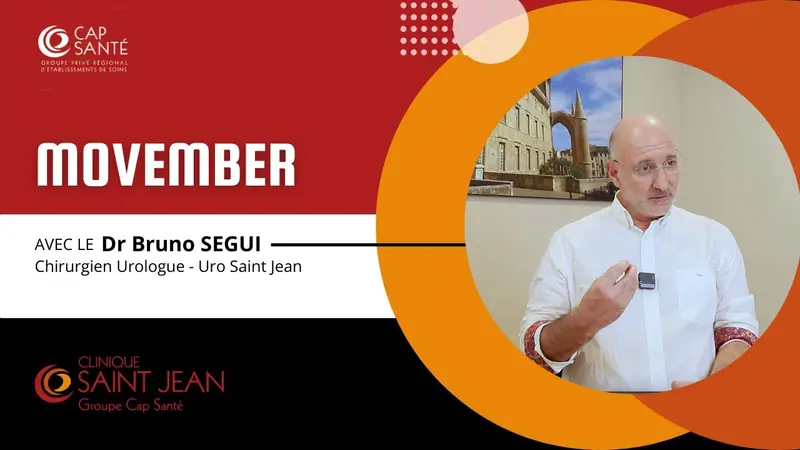
Read the transcript10 min read
Dr Bruno Segui, urological surgeon — Movember interview
0:22 So, Movember means “Mo”, moustache, and “November”: it is a contraction of the two words. It is a movement that was born in Australia, in Melbourne, in 2003, so it is 20 years old. Two friends in a pub, over a beer, decided to bring back the moustache, which was not at all fashionable at the time. They got 30 friends together and said: there are 30 of us, for 30 days, we will bring back the moustache. Then they realised it was getting some attention, and they decided to use that attention to serve the cause of men’s health. The aim is to raise men’s awareness so that they take better care of their health, and to move them a little towards “prevention is better than cure”. They associated it with the colour blue, which is quite gendered. It is currently very popular among young men aged 20 to 40, and you can see moustaches sprouting everywhere.
1:08 So yes, very clearly. Over the last 20 years, we have seen growing involvement from the new generation, the 20- to 40-year-olds. They are more focused on prevention and preserving their health than today’s men in their seventies and eighties. The 70- to 80-year-old men we see today are more focused on cure: they have symptoms, they want to be cured. They are not thinking about prevention. These awareness campaigns have been very effective, we can see that. We also see it in the rise of vasectomy: men are taking an increasing share of responsibility for male contraception, especially this new generation.
1:59 For young men, between 20 and 50, the main concern is testicular cancer. It is a fairly rare cancer, affecting about 2,500 patients a year in France and causing 80 deaths. In 95% of cases, it affects men under 49. The most important thing is to detect it through self-examination, which should be promoted during these campaigns: an increase in the size of the testicle, which becomes hard and irregular. If that is the case, do not hesitate, see a doctor. Men who, as children, had surgery for undescended or ectopic testicles should also be monitored in particular: they were operated on when they were small to bring the testicles down, and they are at higher risk.
2:35 The prostate, on the other hand — which, I would remind you, because it is not obvious to everyone, is a small gland located below the bladder, the size of a chestnut, which produces seminal fluid; seminal fluid, together with the sperm cells that come from the testicles, forms semen — this small gland enlarges with age and compresses the urethra, which causes urinary symptoms. After 50, one man in two will have difficulty passing urine: the stream will be weaker, less powerful, and they will need to urinate more often. That is a benign condition, benign prostatic hyperplasia. That is what makes men see a doctor, whereas, paradoxically, cancer is much more insidious: because it develops in the outer shell of the prostate, at the periphery, it does not interfere with urination. So, for this more insidious cancer, men are advised from the age of 50 to have their PSA, prostate-specific antigen, measured with a simple blood test. The PSA value at 50 gives them an idea of their individual risk of developing prostate cancer or not in the next 10 years. Men aged 50 should be advised to ask their GP for this PSA test.
3:46 As for testicular cancer, treatment is based on orchidectomy, that is, removal of the testicle, often with a prosthesis put in its place. The orchidectomy can sometimes be partial, but most often the testicle is removed completely. Testicular cancer is a difficult diagnosis to announce, because it concerns young people. It often comes as a huge shock, because it is always a heavily loaded word. We need to tell them quickly that it is one of the most curable cancers: the cure rate is about 95% at 5 years. We need to reassure the family quickly, the mothers, the parents. It is one of the most curable cancers, even at the metastatic stage: even patients with metastatic testicular cancer can be cured. It was one of the first metastatic cancers to be cured, with platinum-based drugs. When I was a medical student 25 years ago, we were taught in general oncology that metastatic cancer could not be cured. That is no longer true today: one of the first solid cancers to be cured was testicular cancer. Additional treatments, depending on the type of tumour found when the testicle is analysed, may be radiotherapy, chemotherapy or simply monitoring with regular imaging.
4:55 As for the prostate, you should know that it is a very common cancer: it is the most common cancer in men. About 60,000 new cases of prostate cancer are detected every year in France. There are currently 650,000 men in France living with prostate cancer. It still causes 8,000 deaths. People always say it is a “gentle” cancer that progresses slowly, which is true, but it still kills 8,000 men a year. The best way to prevent these deaths is what we were talking about earlier: early diagnosis through PSA testing. Treatments have improved at every stage, whether at biopsy, diagnosis, surgery — which is less harmful in terms of continence and erection — or radiotherapy, which is better targeted; even treatments for metastatic cancer have made great progress over the last ten years. The key message is that we detect these cancers better, we target them better, and treatments are more personalised and less and less harmful to continence and erection.
5:56 Before thinking about technology… Patients are very keen on technology, on the latest techniques. What we must above all tell patients is to listen carefully to their family doctor, who will refer them to a urologist they can trust, and above all to an experienced multidisciplinary team that will bring excellence and relevance at every stage of care. That is the most important thing: look for a team before looking for a technology. Technology has served our ideas, concepts we had had for a long time, and it has allowed us to put them into practice. For biopsies, for example, we used to take biopsies somewhat blindly in the prostate: MRI and image fusion have allowed us to take more targeted biopsies, which allow better staging of the cancer. Biopsies are now also taken via the transperineal route. In surgery, robotics has given us better vision — three-dimensional vision — with degrees of joint freedom that have allowed finer dissections and a better understanding of surgical anatomy, which has led to improvements in continence and erection. Radiotherapy, which is another way of treating localised prostate cancer, has also made great progress, notably because it is now guided by MRI.
7:07 As for our team at Clinique Saint-Jean, we are lucky to have a bold management that trusts us, because these are heavy financial investments. So we can offer our patients targeted transperineal biopsies: we are one of the few teams in the region able to do so. We of course have the Da Vinci robot. We can also treat localised prostate cancer with high-intensity focused ultrasound, using the Focal One device. And of course we have a multidisciplinary network that allows us to offer our patients the best care at every stage, including day-hospital sessions where different professionals — physiotherapists, dietitians, psychologists — can explain everything properly, for the best possible care. It is not just about technology: the human side is essential, and technology serves people. That is very important to understand.
8:05 My advice to men is not to hesitate to talk about it: first to your family doctor, to a urologist you trust, and avoid friends, neighbours and the internet at first. I would also like to tell them that when you are told you have cancer, you are not alone. Take the time to digest the news. Do not hesitate to talk to patient associations, such as ANAMACaP, the French national association of prostate cancer patients, the Ligue contre le cancer, and an association called Cerhom. You need to talk about it — not to just anyone — but do not hesitate. You also have to understand that, particularly for the prostate, when this cancer is diagnosed there are no symptoms: we have tracked down an insidious cancer that was silent. So you are telling a healthy man that he may need surgery or radiotherapy, which will have harmful effects on his continence and erection, when he feels perfectly well. So I would say to these men: go at your own pace, take the time to take in the information, trust the teams caring for you. And, more generally, I would tell them that a man’s dignity, his strength, his courage in the broadest sense, do not lie only in erection and reproductive function. They know this, but it is always good to remind them.
9:27 Women are directly concerned. It is often still women who bring their men to see us. And when cancer is diagnosed, as we have just discussed, when the man says “I won’t be a man any more”, the woman has a vital role in helping him get through it. Women give life, and it seems that afterwards, throughout life, they are the ones who manage and protect the family’s health: they take the children to the paediatrician for vaccinations, they are used to seeing a gynaecologist. The men of the 70–80 generation we treat today do not have that culture: they associate doctors with illness — “I have no symptoms, I’m not ill, and if I have a symptom, I’ll see the doctor so that he cures me”. So the role of women is very important; they are also often the driving force behind these charity campaigns. I remember French Association of Urology communication campaigns a few years ago: they targeted women’s magazines and media, because we knew it was women who would bring their men to consultations. So, a vital role.
The latest news

New recruit: ALVA.CARE
24/7 virtual secretary
Find out more
Recurrent cystitis, interstitial cystitis: Ialuril offers a new prospect of relief.
Ialuril: a solution for your bladder health has arrived
Find out more
GRACE LABEL 2025
the only GRACE-certified centre in Montpellier for cystectomy
Find out more