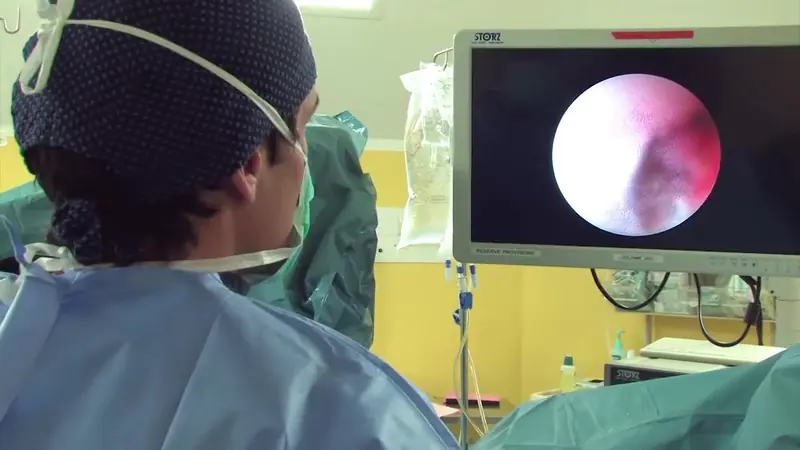
Surgeon following the endoscopic procedure on the operating theatre screen

Thulium laser enucleation of prostate adenoma

Weak stream, urgent needs, getting up at night: prostate adenoma spoils daily life for many men over 50. Thulium laser enucleation removes, in a single operation and without incision, all the tissue compressing the urinary channel. Whatever the size of your prostate.

Reviewed by Dr Vincent Abd El Fattah, urological surgeon · updated on

Key points

  • No incision

    The operation is performed through the natural passages, with a camera passed into the urethra.

  • Prostates of every size

    Even very large adenomas, which used to require open surgery, are treated this way.

  • Little bleeding, short stay

    The laser coagulates as it cuts. Usually one night at the clinic.

  • A lasting result

    The adenoma is removed completely: the risk of needing another operation is very low.

Who is it for?

Enucleation is for men troubled by a prostate adenoma (benign enlargement):

  • when medication is no longer enough, is poorly tolerated, or you do not want to take it for life;
  • in the event of complications: blocked urine (retention), recurrent urinary tract infections, bladder stones, effects on the kidneys, prostate-related bleeding;
  • whatever the size of the prostate, including very large prostates.

Small prostate, wish to preserve ejaculation, anticoagulant treatment: other solutions are also available at our centre — GreenLight laser vaporisation, Rezum, medical treatment. We choose the most suitable one with you.

What does the operation involve?

  1. 1

    The assessment

    Consultation, symptom questionnaire, measurement of the urine stream (uroflowmetry), ultrasound and PSA test: they confirm that the prostate is the cause and measure its size.

  2. 2

    The procedure

    Under anaesthesia, a camera is passed through the urethra. The Thulium laser separates the adenoma from its shell — like removing the flesh of an orange while leaving the peel — then the fragments are pushed into the bladder and suctioned out. It takes 1 to 2 hours depending on the size.

  3. 3

    The first days

    A urinary catheter, with bladder irrigation, is left in for 24 to 48 hours. You usually go home the next day.

  4. 4

    Recovery

    Drink plenty and avoid strain, lifting and cycling for 3 to 4 weeks. Burning and urgent needs may persist for a few weeks while healing takes place.

On video

How enucleation works, in animation

Read the transcript1 min read

Animation narrated in English — transcript

This technique is used for large prostates, over 60 grams. It involves removing the enlarged prostate tissue by cutting it out with a Holmium laser.

A cystoscope is inserted through the urethra with a laser fibre. The high energy of this laser coagulates the blood vessels, which prevents bleeding. The laser fibre separates the enlarged tissue from the prostate capsule, following a natural dissection plane. The prostate tissue is then pushed into the bladder. This technique allows very large prostates to be treated with minimal bleeding.

The prostate tissue placed in the bladder is broken up by a special instrument that sucks in and cuts small fragments. These are then removed, which allows them to be examined under the microscope. The procedure ends with the insertion of a urinary catheter.

The animation shows a Holmium laser: the principle of the operation is the same with the Thulium laser.

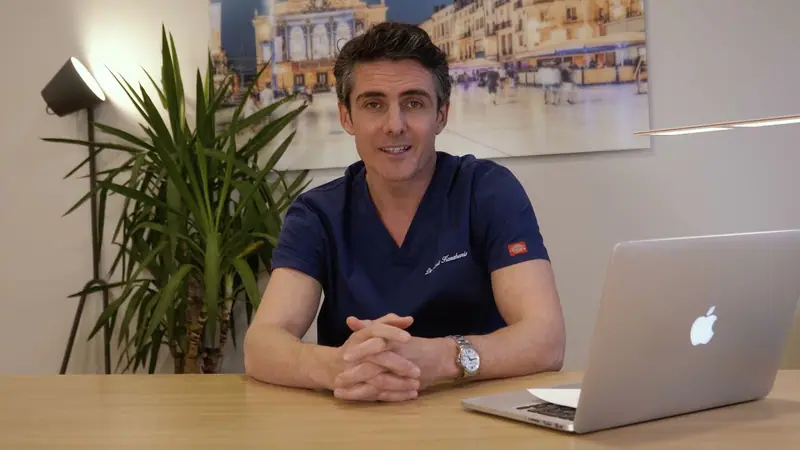
Prostate enlargement explained by Dr KORAHANIS, urologist at Clinique SAINT-JEAN

Video hosted by YouTube: playing it may set cookies.

Read the transcript1 min read

Dr Nicolas Korahanis, urological surgeon

0:15 Benign prostatic hyperplasia is a very common condition in men. It affects about 100,000 men a year in France. It is the second most common operation in men after inguinal hernia repair. It has absolutely nothing to do with prostate cancer.

0:28 In the 21st century, surgery for prostate adenoma is done with lasers. Here at Clinique Saint-Jean, we have two lasers for the prostate: the GreenLight laser and the Holmium laser. The choice of laser depends on the size of your prostate and your other medical conditions: vaporisation or enucleation.

0:46 Enucleation consists of removing as much of the adenoma as possible: it is like hollowing out an orange without breaking the peel. We were the first team in Montpellier to offer this treatment, five years ago now. For very large prostates, we prefer to use a powerful laser to perform the enucleation in the best possible conditions.

1:02 Thanks to our experience of 150 patients a year, our patients stay one day in the clinic, compared with six on average in France, and some procedures can even be done as day surgery.

1:13 If you think these symptoms apply to you, you can fill in a self-assessment questionnaire on our website urosaintjean.com, or come and see us directly in consultation.
After the operation

The urine stream improves as soon as the catheter is removed; urgent needs fade within a few weeks to a few months.

  • The tissue removed is examined under the microscope.
  • Medication for adenoma can usually be stopped.
  • A follow-up consultation is scheduled a few weeks after the operation.

Possible effects

  • Retrograde ejaculation, in the great majority of men operated on: semen goes into the bladder instead of coming out. Orgasm is preserved, but fertility is reduced.
  • Burning, urgent needs, a little blood in the urine for a few weeks. Bleeding may reappear around the 3rd week, when the healing scabs come away: drink plenty.
  • Urinary leakage on exertion or with urgency in the first weeks; it usually subsides, and pelvic floor rehabilitation can help.
  • More rarely: a urinary tract infection, or a narrowing of the urethra requiring an additional procedure.

Erection is generally preserved. At your consultation, your surgeon will explain the risks specific to your situation.

Why choose URO Saint-Jean?

“Today, almost 100% of our operations are done with lasers, in particular the Thulium laser.”

Dr Nicolas Korahanis
  • Three lasers, a tailored choice

    Thulium, Holmium and GreenLight: the technique is chosen according to your prostate and your medication, with a short hospital stay or as day surgery.

  • Surgeons expert in enucleation

    Dr Nicolas Korahanis performed a live Thulium laser enucleation in front of other urologists at the 1st 100% Surgical Meeting organised by the centre in 2023.

  • Every solution for adenoma

    From medical treatment in consultation to Rezum as day surgery and laser surgery: you are not steered towards a single technique.

Your questions

Is it painful?

The operation is performed under anaesthesia. Afterwards, the discomfort is mainly due to the catheter and is relieved by simple painkillers. There is no scar.

How long will I stay in hospital?

Usually one night. The catheter is removed after 24 to 48 hours, and you go home as soon as you are passing urine well.

When will I be able to resume my activities?

Light activities and office work within one to two weeks; sport, cycling and heavy lifting after 3 to 4 weeks, as advised by your surgeon.

Should I stop my anticoagulant treatment?

Never stop it on your own. What to do is decided with your surgeon, your cardiologist and the anaesthetist.

How is it different from the Holmium laser (HoLEP)?

The principle is the same: enucleating the adenoma. Both lasers are available at our centre; your surgeon chooses according to your prostate.

Conditions concerned and surgeons

Page reviewed and approved by Dr Vincent Abd El Fattah, urological surgeon. Updated on . The medical pages of this website are reviewed every year.

Sources

This information does not replace a medical consultation.