
Male urinary symptoms: prostate adenoma
Weak stream, frequent urges, getting up at night: with age, prostate adenoma troubles many men. It is not cancer, and effective solutions exist, from medication to laser treatment, the team’s specialty.
In brief
Prostate adenoma (benign prostatic hyperplasia) is a benign increase in the size of this gland which, by compressing the urinary channel, can cause difficulty when urinating. Treatment depends on how bothersome the symptoms are, the size of the prostate and the patient’s wishes: monitoring, medication or, if treatment fails or complications occur, surgery by endoscopic resection or laser.
At a glance
- 14ein France for prostate adenoma (BPH)1st in Languedoc-Roussillon — Le Point ranking
- 1 dayin hospital on average after prostate laser surgeryCompared with 6 days for conventional surgery
- 150patients treated with laser for adenoma every yearTeam experience, according to Dr Nicolas Korahanis
Key points
Very common
The prostate grows with age: nearly 100,000 men in France see a doctor every year for urinary symptoms.
It is not cancer
Adenoma is a benign enlargement of the prostate.
Assess your symptoms
The IPSS questionnaire measures your urinary symptoms in a few minutes.
Lasers, our specialty
1.3 days in hospital on average at the clinic, compared with 6 days for conventional surgery.
Understanding the condition
The prostate is a gland the size of a chestnut, located below the bladder, surrounding the urine channel (the urethra). As it grows, it squeezes the urethra like a pipe being pinched: the stream weakens and the bladder has to strain to empty.
Epidemiology
Benign prostatic hyperplasia (BPH or prostate adenoma) is very common in men. Its incidence increases with age.
It has nothing to do with prostate cancer!
With age, the prostate grows. Because of its position, it can cause discomfort and difficulty when passing urine.
Having a large prostate does not necessarily mean you will have urinary symptoms. However, nearly 100,000 new men in France every year complain of urinary symptoms that may be related to this enlargement.
Transurethral resection of the prostate is the second most common operation in men after inguinal hernia repair.
On average, one man in 10 will need surgery for BPH.
Benign prostatic hyperplasia explained on video by Dr Nicolas Korahanis

Read the transcript1 min read
Dr Nicolas Korahanis, urological surgeon
0:15 Benign prostatic hyperplasia is a very common condition in men. It affects about 100,000 men a year in France. It is the second most common operation in men after inguinal hernia repair. It has absolutely nothing to do with prostate cancer.
0:28 In the 21st century, surgery for prostate adenoma is done with lasers. Here at Clinique Saint-Jean, we have two lasers for the prostate: the GreenLight laser and the Holmium laser. The choice of laser depends on the size of your prostate and your other medical conditions: vaporisation or enucleation.
0:46 Enucleation consists of removing as much of the adenoma as possible: it is like hollowing out an orange without breaking the peel. We were the first team in Montpellier to offer this treatment, five years ago now. For very large prostates, we prefer to use a powerful laser to perform the enucleation in the best possible conditions.
1:02 Thanks to our experience of 150 patients a year, our patients stay one day in the clinic, compared with six on average in France, and some procedures can even be done as day surgery.
1:13 If you think these symptoms apply to you, you can fill in a self-assessment questionnaire on our website urosaintjean.com, or come and see us directly in consultation.
Symptoms
The signs suggesting BPH-related symptoms are:
These signs are not specific to adenoma: they should always be assessed by a doctor. The IPSS questionnaire helps you measure your symptoms before the consultation.
- a weak stream,
- having to get up several times at night to urinate,
- frequent urination,
- having to strain to urinate,
- a sudden, urgent need to urinate (having to go very quickly),
- urinary leakage,
- a feeling that the bladder has not emptied properly,
- sometimes haematuria (blood in the urine)
Diagnosis
Questions and examination
Questions: answering the IPSS score.
Clinical examination: a digital rectal examination allows your surgeon to estimate the size of the prostate and sometimes to detect prostate cancer.
Further tests
A PSA level (blood test) may be needed to complete prostate cancer screening.
A prostate ultrasound will estimate its weight and its effects (post-void residual urine).
Uroflowmetry (you urinate into a device that measures the strength of the stream) often completes the assessment. A bladder diary, in which you note the time and volume of each urination for 3 days, helps to understand night-time waking.
Treatments
From simple monitoring to laser surgery: treatment depends on your symptoms, the size of the prostate and your wishes.
Laser on video
Video presentation of laser enucleation of a prostate adenoma
Read the transcript1 min read
Animation narrated in English — transcript
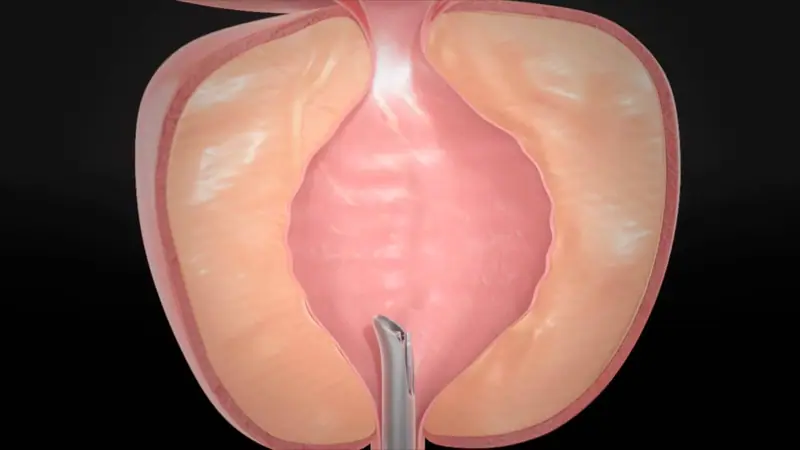
This technique is used for large prostates, over 60 grams. It involves removing the enlarged prostate tissue by cutting it out with a Holmium laser.
A cystoscope is inserted through the urethra with a laser fibre. The high energy of this laser coagulates the blood vessels, which prevents bleeding. The laser fibre separates the enlarged tissue from the prostate capsule, following a natural dissection plane. The prostate tissue is then pushed into the bladder. This technique allows very large prostates to be treated with minimal bleeding.
The prostate tissue placed in the bladder is broken up by a special instrument that sucks in and cuts small fragments. These are then removed, which allows them to be examined under the microscope. The procedure ends with the insertion of a urinary catheter.
Video presentation of laser vaporisation of a prostate adenoma
Documentation

Your care at the practice
At the practice, this care is provided by Dr Nicolas Korahanis, Dr Samer Abdel-Hamid, Dr Vincent Abd El Fattah and Dr Bruno Segui.
Consultations take place at the Consultation Centre, in Saint-Jean-de-Védas, and at Polyclinique Saint-Louis, in Ganges. Depending on the operation, it is performed at Clinique Saint-Jean Sud de France or at Polyclinique Saint-Louis.
Techniques used at the practice: Laser surgery, Thulium laser enucleation, Rezum.
Why choose URO Saint-Jean?
Several lasers in the operating theatre
GreenLight, Holmium, Thulium: the technique is chosen according to your prostate and your medication.
A short stay
1.3 days in hospital on average, and day surgery whenever possible.
A specialist team
About 120 patients operated on with lasers every year.




Your questions
Can adenoma turn into cancer?
No. They are two different diseases, although they can coexist: this is why cancer screening (digital rectal examination, PSA) may be offered during your assessment.
Should all large prostates be operated on?
No: what matters is the discomfort and complications, not the size. Many men are relieved by medical treatment.
Does the operation affect erections?
As a rule, no: adenoma surgery does not affect the erectile nerves. Ejaculation, however, often goes back into the bladder (retrograde ejaculation), except with certain techniques that preserve it.
How long is the catheter kept in?
With the laser, the catheter is kept in only briefly: it is usually removed the day after the operation.
Page reviewed and approved by Dr Nicolas Korahanis, urological surgeon. Updated on . The medical pages of this website are reviewed every year.
Sources
- Hypertrophie benigne de la prostate (espace patients, questions / réponses) — Association française d’urologie (AFU)
- Fiche info patient — Vaporisation laser de la prostate — Association française d’urologie (AFU), 2025
- Qu’est-ce que l’adénome de la prostate ? — Assurance maladie (ameli.fr), 2024
This information does not replace a medical consultation.