
Contraceptive vasectomy
Permanent, simple contraception that is 99.8% effective: a 15- to 30-minute day-surgery procedure that changes nothing about your sex life.
In brief
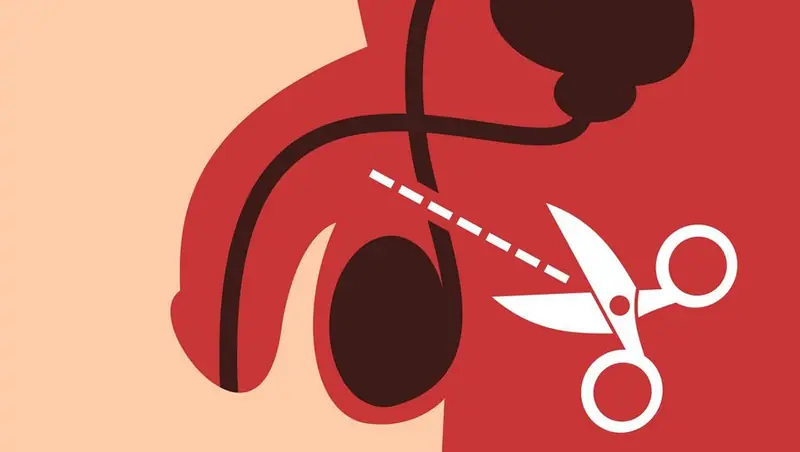
Vasectomy is a permanent form of male contraception: the vasa deferentia, through which the sperm produced by the testicles travel, are divided through tiny incisions on each side of the scrotum. After an information consultation and a reflection period required by law, the procedure is carried out as day surgery, under local or general anaesthesia; the usual contraception is continued until a follow-up semen analysis confirms that there are no sperm.
Key points
Length of procedure
15 to 30 min
Length of stay
Day procedure : you go home the same day.
General or local anaesthesia
The choice is made with your surgeon and the anaesthetist.
“No-scalpel” technique
Two tiny incisions, one on each side of the scrotum.
99.8% effective
One of the most effective forms of contraception.
A safe method
Less than 1% complications.
Your journey in 3 steps
- 1
The information consultation
The urologist explains the procedure and its consequences. French law then requires a 4-month reflection period, followed by written confirmation.
- 2
The procedure
15 to 30 minutes, as day surgery, under local or general anaesthesia, through two tiny incisions. A few days of taking it easy are enough.
- 3
The follow-up semen analysis
Keep using your usual contraception until a semen analysis, 2 to 3 months later, confirms that there are no sperm.
All about vasectomy
Who can use this method?
Vasectomy is for people who do not intend, or no longer intend, to have children.
Legally, in France, any adult who has “expressed a free, motivated and deliberate wish in the light of clear and complete information about its consequences” should be able to obtain sterilisation
In France, this long-marginal practice is growing very quickly: nearly 58,000 vasectomies were performed in 2025, compared with 2,150 in 2010 (Epi-Phare study, 2026). In Quebec, one sexually active man in five has had a vasectomy, and one in three among 45- to 64-year-olds. There, this method is chosen at least four times more often than tubal ligation. In France, vasectomies have even outnumbered female sterilisations since 2021.
In Great Britain and Canada, vasectomy is used by more than 20% of couples. In Belgium, Spain and Switzerland, the proportion is about 8%.
This method is most often used by couples who have had the children they want. Their motivation is then to free the woman from the constraints of contraception. Sterilisation is a much simpler operation in men than in women.
What does the operation involve?
The vasa deferentia are divided through 2 tiny skin incisions made on each side of the scrotum
The operation is performed under general or local anaesthesia.
It takes between 15 and 30 minutes and is performed as day surgery
Semen is mainly made up of secretions from the prostate and seminal vesicles. Sperm cells make up only an insignificant part. Produced by the testicles, they normally travel through the vasa deferentia. These are the tubes that are operated on, so that the semen no longer contains sperm.
As the seminal vesicles store sperm, the method is not immediately effective. It takes 2 to 3 months before a semen analysis can confirm that there are no sperm in the ejaculate.
Is your sex life affected?
Vasectomy does not harm your sex life in any way.
The hormonal function of the testicles is not disturbed, libido is preserved and erections are not affected in any way.
There are no changes in ejaculation. Almost all the semen is produced by the prostate and seminal vesicles. The testicles produce only the sperm, which make up just two to three per cent of the volume of the ejaculate. The semen looks the same.
Being free of the constraints of contraception often contributes to a more fulfilling sex life.
What are the steps?
Your GP should refer you to a urologist, who will give you clear and complete information about the operation and its consequences. If you then express a free, motivated and deliberate wish, the urologist may give you a written summary of this information. A four-month reflection period is required by law. You will then have to confirm your wish in writing
Doctors are never obliged to perform this procedure, but they must tell you of their refusal at the first consultation.
Is the operation risky?
the rate of post-operative complications is low.
Minor complications (infection, haematoma, pain) may occur, but it is exceptional to need further surgery.
Studies to date show no causal link between prostate cancer and vasectomy. Nor does there appear to be any increase in cardiovascular disease or in any type of cancer among patients who have had a vasectomy, in retrospective cohort studies.
Is the operation reversible?
In countries where vasectomy is common, men rarely express regret afterwards: 6% in the United States, 3 to 4% in Quebec.
An operation to reconnect the tubes exists, called vasovasostomy, but it leads to a pregnancy in only 40 to 50% of cases.
It is also possible to store sperm for many years at very low temperature for possible assisted reproduction. Your urologist will explain and offer this at the information appointment.
Is vasectomy reliable?
Vasectomy is one of the most effective methods of contraception. No method is 100% reliable, but vasectomy is 99.8% effective. By comparison, the pill is 91% effective, which means that out of 100 women using this method, 9 will have an unplanned pregnancy in the first year of use. Condoms are only 85% effective.
The pill is considered a theoretically reliable method, but in practice, according to the latest survey, 23% of women who had an abortion were using this method of contraception.
As for women…
The French Association of Urology writes:
“Compared with bilateral tubal ligation, vasectomy carries a lower risk of serious complications and is less expensive. Vasectomy should therefore be preferred to bilateral tubal ligation in most cases.”
Vasectomy is a simple procedure taking 15 to 30 minutes, whereas sterilisation in women requires a more major operation. Yet female sterilisation is the most widely used method worldwide.
The complications of surgical tubal ligation, although also rare, are potentially much more serious (infection, bowel or blood vessel injury, haemorrhage, death)
What precautions should I take after the operation?
A few days of taking it easy, well-fitting underwear and ice if needed. Avoid sport and strain for about a week. Sexual intercourse can resume after a few days, while continuing to use contraception until the follow-up semen analysis.
The operation on video
Vasectomy explained on video
Documentation

Your care at the practice
At the practice, this care is provided by Dr Nicolas Korahanis, Dr Samer Abdel-Hamid, Dr Vincent Abd El Fattah and Dr Bruno Segui.
Consultations take place at the Consultation Centre, in Saint-Jean-de-Védas, and at Polyclinique Saint-Louis, in Ganges. Depending on the operation, it is performed at Clinique Saint-Jean Sud de France or at Polyclinique Saint-Louis.
Why choose URO Saint-Jean?
A “no-scalpel” technique
Two tiny incisions, little pain and a quick recovery.
Day surgery
You go home on the day of the operation.
Time to decide
A dedicated consultation so that you can choose with peace of mind, respecting the legal reflection period.




Page reviewed and approved by Dr Nicolas Korahanis, urological surgeon. Updated on . The medical pages of this website are reviewed every year.
Sources
- Fiche info patient – Vasectomie contraceptive — Association française d’urologie (AFU), 2024
- Stérilisation à visée contraceptive chez l’homme et chez la femme — Haute Autorité de santé (HAS), 2019
- Stérilisation à visée contraceptive chez l’homme et chez la femme — Assurance maladie (ameli.fr), 2024
This information does not replace a medical consultation.