At the cutting edge of technology
Robot-assisted surgery
Minimally invasive surgery that benefits the patient’s quality of life.
Key points
incisions of only 8 mm
3D vision
A stable view and remarkable visibility for the surgeon.
The benefits
- Better visibility for the surgeon
- Minimally invasive surgery in hard-to-reach areas
- Fewer visible scars
- Precise dissection
Who is in control?
“The surgery is performed entirely by your doctor.”
 Da Vinci robot: the feats of robotic surgery
Surgery is the main curative treatment for cancer
Clinique SAINT JEAN Sud de France has invested in the development of robot-assisted surgery (or robotic surgery)
minimally invasive surgery that benefits the patient’s quality of life.
This technique offers the advantages of open surgery while using the small incisions of laparoscopic surgery.
The benefits of robotic surgery
Who is in control?
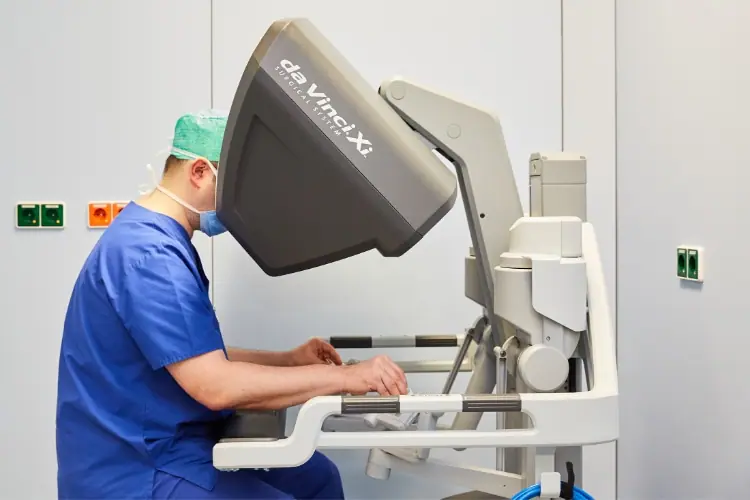
Your surgeon controls the da Vinci system, which translates the movements of his hands into much finer and more precise movements of small instruments placed inside your body.
Your surgeon, located beside you, controls the whole operation, operating the camera and directing the instruments.
Although it is often called a “robot”, the da Vinci system cannot act on its own: the surgery is performed entirely by your doctor.
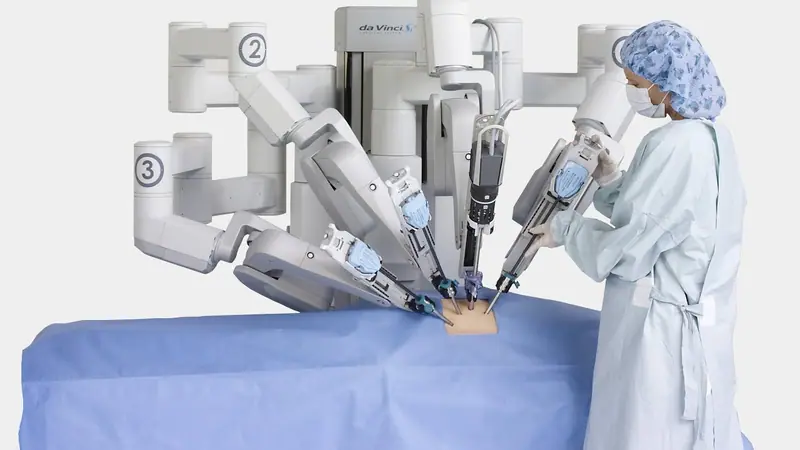
Da Vinci technology allows your doctor to perform complex procedures through just a few small incisions.
This allows you to return to normal life more quickly, without the convalescence usually associated with major surgery.
Read the transcript1 min read
Animation narrated in English — transcript
Localised prostate cancer. The robotic approach allows the surgery to be performed in a minimally invasive way, reproducing the steps of open and laparoscopic surgery, with 3D vision and great precision, more easily and ergonomically than with conventional laparoscopy, thanks to the robot’s freedom of movement and elimination of tremor.
After the pneumoperitoneum has been created, five trocars are inserted: one for the camera, three for the robotic instruments and one for the assistant. The robot is then docked and the operation begins.
Dissection of the space of Retzius, opening of both sides of the endopelvic fascia and ligation of the superficial venous complex. Dissection of the bladder neck, then identification and dissection of the seminal vesicles and vasa deferentia.
At this stage, electrocautery is avoided to limit nerve damage. The neurovascular bundles are separated from the prostate: they are a thin layer around the prostate, within the prostatic fascia, that contains the nerves responsible for erection.
Dissection, ligation and division of the deep dorsal venous complex, or Santorini’s plexus, and of the puboprostatic ligaments, then division of the urethra at the apex of the prostate.
The operation ends with the suture between the bladder and the urethra (vesicourethral anastomosis), insertion of a urinary catheter, extraction of the prostate and removal of the trocars. Robotic assistance really helps to preserve the nerves and perform the vesicourethral anastomosis.
Da Vinci robot: the feats of robotic surgery
The robot in pictures
Conditions concerned and surgeons
This technique is used for: Prostate cancer, Kidney cancer, Bladder cancer.
It is performed by Dr Nicolas Korahanis, Dr Samer Abdel-Hamid, Dr Vincent Abd El Fattah and Dr Bruno Segui.
Page reviewed and approved by Dr Samer Abdel-Hamid, urological surgeon. Updated on . The medical pages of this website are reviewed every year.
Sources
- Fiche info patient — Chirurgie cœlioscopique robot-assistée — Association française d’urologie (AFU), 2018
- Évaluation des dimensions clinique et organisationnelle de la chirurgie robot-assistée dans le cadre d’une prostatectomie totale — Haute Autorité de santé (HAS), 2016
- Fiche info patient — Prostatectomie totale — Association française d’urologie (AFU), 2025
This information does not replace a medical consultation.