minimally invasive treatment for prostate enlargement (BPH)
Treating BPH with water vapour (Rezum)
A minimally invasive treatment for benign prostatic hyperplasia that uses the energy of water vapour.
Key points
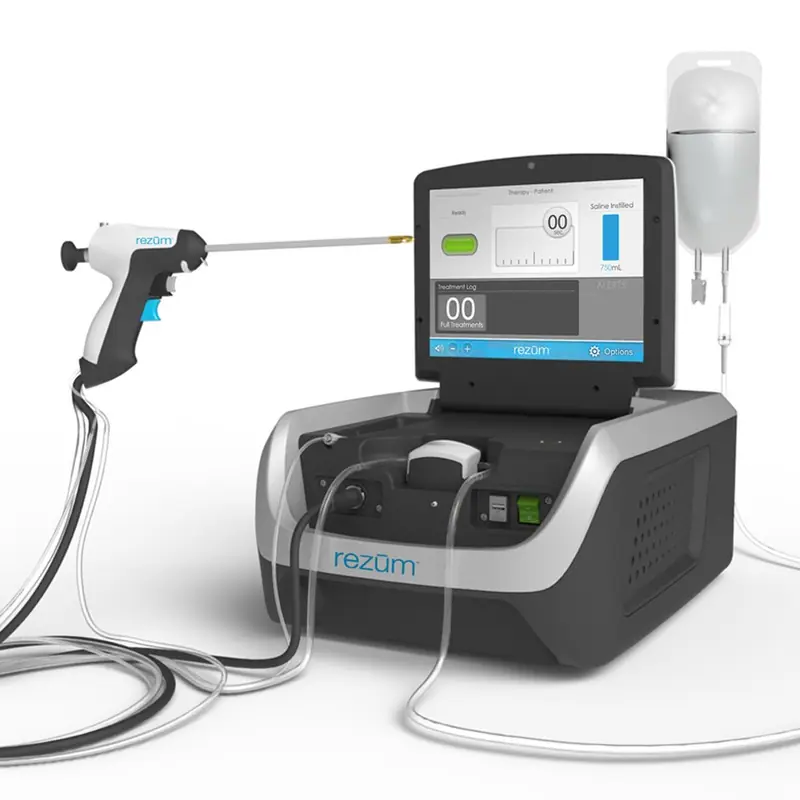
Water vapour
A small probe delivers it directly into the affected area of the prostate.
Day procedure
In most cases: a rapid return to daily activities.
Benefits for patients
- Reduced risk
- Lasting effectiveness
- Better quality of life
- Day procedure
- Avoids long-term medication
Lasting effectiveness
Long-term relief of urinary symptoms.
 The REZUM technique: a major advance in the treatment of benign prostatic hyperplasia
What is Rezum?
REZUM is an innovative procedure that uses the energy of water vapour to treat benign prostatic hyperplasia. Unlike traditional methods such as surgery or medication, REZUM offers a minimally invasive and effective approach.
How does Rezum work?
The REZUM procedure uses a small probe that delivers water vapour directly into the affected area of the prostate. The water vapour penetrates the prostate cells, causing them to shrink and relieving the symptoms of enlargement. The process is precise and targeted, and minimises unwanted side effects.
Benefits for patients
Rezum on video
The REZUM technique: a major advance in the treatment of benign prostatic hyperplasia
Read the transcript2 min read
Dr Nicolas Korahanis, urological surgeon
0:15 Hello, I am Dr Nicolas Korahanis, urological surgeon at Clinique Saint-Jean Sud de France in Montpellier.
0:25 Benign prostatic hyperplasia, or prostate adenoma, is a benign condition of older men in which the prostate increases in size. It can cause several symptoms: a weak urine stream, difficulty starting, or urgent or very frequent urination. These symptoms are very common: nearly 2 million men in France will be affected by this condition, about 10% of whom will need surgery. It is the second most common operation in men, after inguinal hernia repair.
1:01 Rezum is an innovative procedure developed to treat prostate adenoma with a minimally invasive technique, using water vapour. Water vapour is injected into the prostate endoscopically: a small needle is inserted into the prostate, which is heated to a very high temperature. As a result of the heat, the prostate cells die, the prostate shrinks and the symptoms improve.
1:28 The main advantages of Rezum are that it is minimally invasive, with very few side effects, and that it can be done as day surgery: you do not stay overnight at the clinic. Rezum is an alternative to alpha-blocker medication and is just as effective. Its advantage is that it is a surgical technique with very few side effects, in particular the side effect men fear most, retrograde ejaculation, which occurs with laser surgery. With Rezum, retrograde ejaculation occurs in only about 10% of cases, compared with almost 90 to 95% with laser.
2:04 The Rezum procedure sits between medical treatment, or replaces it, and conventional surgical treatment, which today mainly means laser resection; this remains the reference technique, the “gold standard”, with the best results. The principle is simple: we clear the obstruction in the prostate as much as possible, removing the prostate tissue that blocks the flow of urine. Today, almost 100% of our operations are done with lasers, in particular the Thulium laser, but it can also be a GreenLight or Holmium laser.
2:36 Here at Clinique Saint-Jean, my partners and I have the full range of treatments for benign prostatic hyperplasia: from medical treatment in consultation, to Rezum as a day procedure, and of course conventional laser surgery.
REZUM: treating prostate enlargement with water vapour
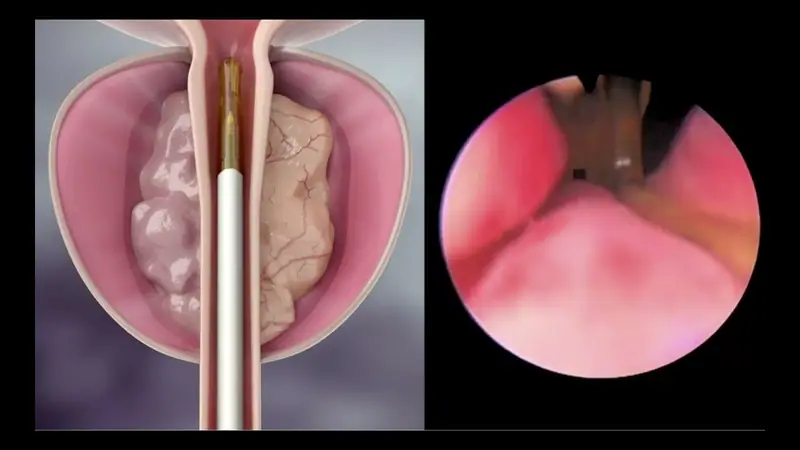
Video without narration
Risks and limitations
Like any treatment, Rezum has side effects and limitations. The data below come from published studies, each cited with its reference. Your surgeon will explain what applies to your situation.
After the operation
- The most common effects are discomfort or burning when passing urine (about 21% of patients) and blood in the urine (about 14%), according to a meta-analysis of 8 studies covering 1,015 patients (Yang et al., 2023).
- According to the 2020 Cochrane review (a single trial, 197 men), the treatment probably greatly increases the proportion of men who need a urinary catheter after the procedure, compared with a sham procedure (Kang et al., 2020).
- In the pivotal trial (136 men treated), the symptom score went from 22 before treatment to 18.6 at 2 weeks, then the reduction reached 50% or more at 3, 6 and 12 months (McVary et al., 2016).
Risks
- According to a review of 19 studies (1,942 patients), side effects are reported in 0 to 76% of patients depending on the study (median: 29%); most are not serious and are temporary (Babar et al., 2022).
- The most common are burning when passing urine, urinary retention (blockage) and urinary tract infection (meta-analysis of 4 studies, 514 patients, median follow-up of 2 years; Miller et al., 2020).
- The risk of a serious complication is not known precisely: the 2020 Cochrane review considers the data very uncertain on this point (Kang et al., 2020).
- Absence of ejaculation is reported in about 3% of patients treated with Rezum, according to a systematic review of 24 studies of minimally invasive prostate treatments (Franco et al., 2026).
- New erection problems are reported in 0 to 3.1% of patients (Babar et al., 2022).
Limitations
- The improvement in symptoms is smaller than after transurethral resection of the prostate, with fewer complications in return (randomised trial of 100 patients, prostates of 50 to 120 g, 2-year follow-up; Samir et al., 2024).
- For prostates of 80 cm³ and above, the published studies are mostly retrospective, with short follow-up (median of 6 months): the long-term results are not known (McVary et al., 2024).
- In 2020, the Cochrane review judged the level of evidence to be moderate to very low: it was based on a single trial, funded by the manufacturer, with a comparison against a sham procedure limited to 3 months (Kang et al., 2020).
- In its 2025 update, the specialist committee of the French Association of Urology (AFU) states that Rezum may be offered to men with moderate to severe urinary symptoms who wish to preserve ejaculation and whose prostate measures 30 to 80 mL (Klein et al., 2025). In 2021, it regarded it as a technique still under evaluation (Lebdai et al., 2021).
Long-term results
- In the reference trial (197 men, prostate of 30 to 80 cm³, 5-year follow-up), the symptom score was reduced by 48% at 5 years in the treated group, and the rate of further surgery was 4.4% (McVary et al., 2021).
- According to a review of 19 studies, further surgery was needed in 4.4% to 7.5% of patients at 5 years (Babar et al., 2022).
Conditions concerned and surgeons
This technique is used for: Male urinary symptoms: prostate adenoma.
It is performed by Dr Nicolas Korahanis, Dr Samer Abdel-Hamid, Dr Vincent Abd El Fattah and Dr Bruno Segui.
Page reviewed and approved by Dr Bruno Segui, urological surgeon. Updated on . The medical pages of this website are reviewed every year.
Sources
- Fiche info patient — REZUM : traitement par injections intraprostatiques de vapeur d’eau — Association française d’urologie (AFU), 2025
- REZUM — Avis de la CNEDiMTS du 7 juin 2022 (Kit d’administration pour le traitement de l’hypertrophie bénigne de la prostate) — Haute Autorité de santé (HAS), 2022
- Note de cadrage — Prise en charge des troubles mictionnels de l’homme en lien avec une Hypertrophie Bénigne de la Prostate en soins primaires — Haute Autorité de santé (HAS), 2024
Scientific references
- Yang J, et al. Efficacy and safety of Water Vapor Thermal Therapy in the treatment of benign prostate hyperplasia: a systematic review and single-arm meta-analysis. BMC Urology. 2023. doi:10.1186/s12894-023-01237-2
- Kang TW, et al. Convective radiofrequency water vapour thermal therapy for lower urinary tract symptoms in men with benign prostatic hyperplasia. Cochrane Database of Systematic Reviews. 2020. doi:10.1002/14651858.CD013251.pub2
- McVary KT, et al. Minimally Invasive Prostate Convective Water Vapor Energy Ablation: A Multicenter, Randomized, Controlled Study. The Journal of Urology. 2016. doi:10.1016/j.juro.2015.10.181
- Babar M, et al. Emerging outcomes of water vapor thermal therapy (Rezum) in a broad range of patients with lower urinary tract symptoms secondary to benign prostatic hyperplasia: a systematic review. LUTS: Lower Urinary Tract Symptoms. 2022. doi:10.1111/luts.12435
- Miller LE, et al. Water vapor thermal therapy for lower urinary tract symptoms secondary to benign prostatic hyperplasia: systematic review and meta-analysis. Medicine. 2020. doi:10.1097/MD.0000000000021365
- Franco A, et al. Systematic Review and Pooled Analysis of Functional and Sexual Outcomes of Minimally Invasive Surgical Treatments for Benign Prostatic Obstruction. European Urology. 2026. doi:10.1016/j.eururo.2025.09.004
- Samir M, et al. Two-year follow-up comparing Rezūm therapy versus bipolar transurethral resection of the prostate for treating benign prostatic hyperplasia: a prospective randomized study. International Journal of Urology. 2024. doi:10.1111/iju.15410
- McVary KT, et al. Water Vapor Thermal Therapy in Men With Prostate Volume ≥80 cm³: A Systematic Review and Meta-Analysis. Urology. 2024. doi:10.1016/j.urology.2023.10.036
- Klein C, et al. Surgical and interventional management of bladder outlet obstruction related to benign prostatic hyperplasia: clinical practice guidelines of the French Association of Urology. The French Journal of Urology. 2025. doi:10.1016/j.fjurol.2025.102951
- Lebdai S, et al. Prise en charge chirurgicale et interventionnelle de l’obstruction prostatique bénigne : recommandations du Comité des troubles mictionnels de l’homme de l’AFU. Progrès en urologie. 2021. doi:10.1016/j.purol.2020.12.006
- McVary KT, et al. Final 5-Year Outcomes of the Multicenter Randomized Sham-Controlled Trial of a Water Vapor Thermal Therapy. The Journal of Urology. 2021. doi:10.1097/JU.0000000000001778
This information does not replace a medical consultation.