Draft text, awaiting review by a surgeon. In the meantime, this page is not submitted to search engines.
Urinary endoscopy and lithotripsy
Ureteroscopy (endoscopy through the natural passages, with laser fragmentation) and extracorporeal lithotripsy (shock waves produced outside the body) are techniques for treating urinary stones, without incision. This page describes these techniques; the disease, the renal colic attack and prevention are explained on the Kidney stones page.
For which stones
A small stone that causes no discomfort and does not block the kidney can simply be monitored. Many pass on their own in the urine, sometimes helped by a medicine that relaxes the ureter.
In an emergency or for a large stone, several techniques are possible.
- Rigid ureteroscopy: the instrument passes through the natural passages into the ureter to reach the stone directly.
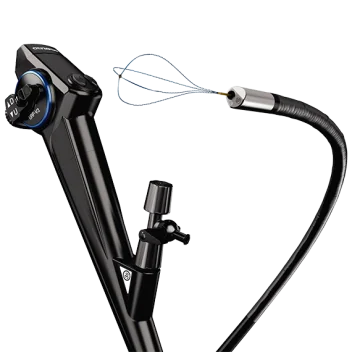
- Flexible ureteroscopy: the instrument passes through the natural passages into the kidney to reach the stone directly.
- Stone that has resisted extracorporeal lithotripsy: ureteroscopy can be used to break it up or remove it.
- Ureteroscopy as first-line treatment in certain situations, for example: obesity, anticoagulant treatment, when rapid treatment is desired.
- Emergency procedure required, without fever: the surgeon always tries to remove or break up the stone with a ureteroscope and the laser, if the stone is accessible. This depends on its size and position: the higher it is, the harder it is to reach.
- Complicated renal colic with fever: the urine is drained with a JJ stent.
The techniques
Recovery and limitations
Extracorporeal lithotripsy. Recovery is straightforward. Occasionally the stone resists ESWL: further treatment of a different kind is then needed.
Emergency ureteroscopy. Whether the stone can be removed depends on its size and position: the higher it is, the harder it is to reach.
JJ stent. It can cause a frequent urge to urinate, discomfort in the lower back when urinating or a little blood in the urine. These effects disappear when it is removed.
Going home after day surgery. A few hours are needed between the end of the procedure and your departure. An accompanying person is required when you leave. You must not stay alone on the first night, or drive until the following day. You must also meet the medical criteria for discharge. See the Surgery page.
Follow-up. Depending on your case, a follow-up consultation is scheduled in the days or weeks after the procedure. The date is set before you leave. In an emergency outside the practice’s opening hours, you can go to the clinic’s emergency department: if your problem requires it, the on-call urologist can step in. See the Follow-up page.
Recurrence. Half of patients have a recurrence within 5 years: prevention matters as much as treatment. It is explained on the Kidney stones page, which also gives access to an information sheet from the French Association of Urology (AFU).
Where
- Extracorporeal lithotripsy: only at Clinique Saint-Jean Sud de France, in Saint-Jean-de-Védas.
- Ureteroscopy and laser: at Clinique Saint-Jean Sud de France, which is equipped with a digital flexible ureteroscope and a Holmium laser for stones. The urologists also operate at Polyclinique Saint-Louis in Ganges, which has acquired a stone laser and digital ureteroscopes for the treatment of upper urinary tract stones.
- Emergencies: the Clinique Saint-Jean emergency department treats renal colic 24 hours a day, 7 days a week, with an on-site CT scanner and rapid advice from the urological surgeons. See the SOS kidney stones 24/7 page.
- Consultations: at the Consultation Centre, 2 rond-point de l'Europe, 34430 Saint-Jean-de-Védas (04 34 35 24 88), and at Polyclinique Saint-Louis in Ganges (04 67 81 68 76). Appointments are booked online or by phone.
Your questions
Are you put to sleep during extracorporeal lithotripsy?
You are not fully put to sleep. The session lasts 45 minutes on the machine, after the stone has been located by your urologist, assisted by the technician.
What happens if the stone resists extracorporeal lithotripsy?
Occasionally the stone resists ESWL. Further treatment of a different kind is then needed. Ureteroscopy can be used to break up or remove stones that resist ESWL.
How long do you stay at the clinic?
For extracorporeal lithotripsy, the hospital stay is short, lasting a few hours. Ureteroscopy is performed as day surgery. These procedures take less than an hour.
Is a JJ stent uncomfortable?
It can cause a frequent urge to urinate, discomfort in the lower back when urinating or a little blood in the urine. These effects disappear when it is removed, a quick procedure usually done without general anaesthesia.
Can a stone pass on its own?
Yes, small stones often pass spontaneously within a few days to a few weeks. Straining your urine allows you to collect the stone so that it can be analysed. See the Kidney stones page.
Conditions concerned and surgeons
This technique relates to: Kidney stones.
It is performed by Dr Nicolas Korahanis, Dr Samer Abdel-Hamid, Dr Vincent Abd El Fattah and Dr Bruno Segui.