
Urogenital infections
Prostatitis, epididymo-orchitis, pyelonephritis, recurrent cystitis: urogenital infections are common. Properly diagnosed, with a urine test before any treatment, they can be treated effectively.
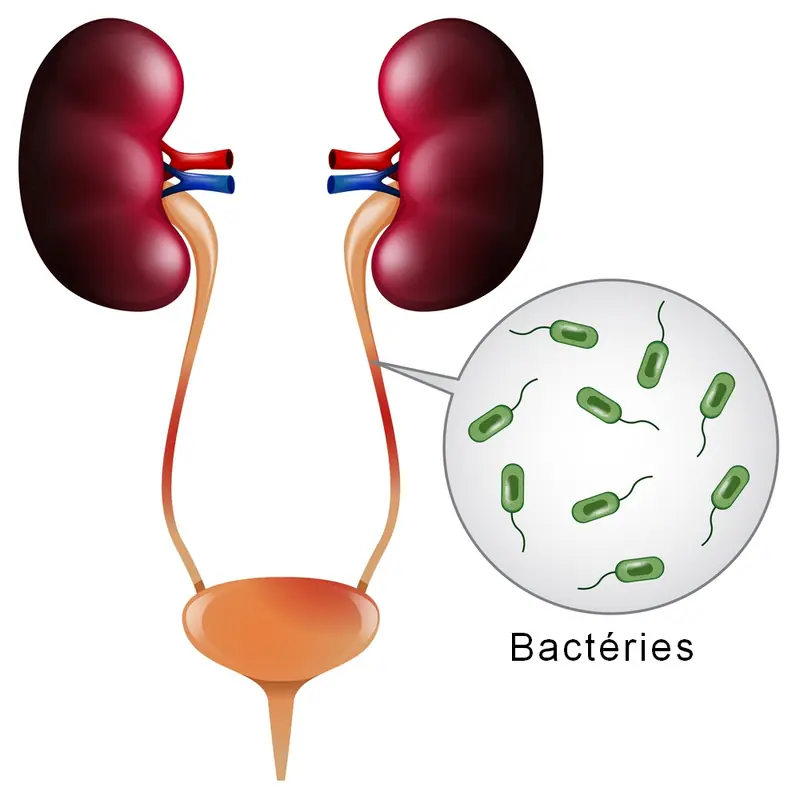
In brief
Prostatitis (infection of the prostate), epididymo-orchitis (infection of the testicle), pyelonephritis (infection of the kidney) and recurrent cystitis (frequent recurrences of lower urinary tract infections) are common urogenital infections. Depending on the infection, diagnosis relies on a urine test (urine culture), a blood test, an ultrasound or a CT scan, and treatment on antibiotics; for recurrent cystitis, lifestyle measures and preventive treatments are added.
Key points
Urine test first
The urine culture (ECBU) identifies the germ so that the right antibiotic can be chosen.
Fever: see a doctor quickly
A urinary tract infection with fever or back pain must be treated without delay.
Cystitis, very common
10 to 30% of women have had it at least once.
Preventing recurrence
A few simple measures, and new treatments such as Ialuril instillations.
The infections
Recurrent cystitis
This means frequent recurrence of lower urinary tract infections (more than 4 episodes a year). It affects young women. 10 to 30% of women have had cystitis at least once in their lives. It is due to germs travelling up the short female urethra.
With recurrent cystitis, there is a risk of developing resistance to antibiotics. A urine test (urine culture) is essential before starting treatment.
The management of recurrent urinary tract infections involves checking that lifestyle and dietary measures are followed, trying long-term alternating antibiotic treatment (3 to 6 months), urinary acidifiers such as cranberry and, finally, sometimes surgery (urethral dilatation). One of the differential diagnoses of recurrent infections may be interstitial cystitis (AFU sheet, in French).
A new treatment by bladder instillation (Ialuril) is now available for the prevention of recurrent cystitis
A meta-analysis published in the International Urogynecology Journal (Goddard and Janssen, 2018), covering eight studies including two randomised trials, concludes that instillations of hyaluronic acid, alone or combined with chondroitin sulphate, appear to reduce the number of urinary tract infections and to lengthen the time to recurrence in women prone to recurrences; the authors stress the small number of studies and patients. The protective action on the urothelium (the lining of the bladder) makes the wall less adherent to bacteria.
- Drink 1.5 to 2 litres of water a day
- Pass urine regularly, without holding it in, and after intercourse
- Wipe from front to back
- Avoid constipation
- Use gentle intimate hygiene products, avoiding harsh ones
These simple measures are the “lifestyle and dietary measures” that reduce the risk of recurrence.
Your care at the practice
At the practice, this care is provided by Dr Nicolas Korahanis, Dr Samer Abdel-Hamid, Dr Vincent Abd El Fattah and Dr Bruno Segui.
Consultations take place at the Consultation Centre, in Saint-Jean-de-Védas, and at Polyclinique Saint-Louis, in Ganges. Depending on the operation, it is performed at Clinique Saint-Jean Sud de France or at Polyclinique Saint-Louis.
Why choose URO Saint-Jean?
A full assessment
Looking for a cause that makes infections more likely: stone, obstruction, bladder abnormality.
SOS kidney stones 24/7
An infection in a kidney blocked by a stone is treated as an emergency, day and night.
Ialuril at the clinic
Instillations to prevent recurrent cystitis.




Your questions
Is a urine test always needed?
For simple cystitis, a urine dipstick is often enough. But with fever, recurrence, in men or during pregnancy, a urine culture is essential to choose the right antibiotic.
Is cranberry effective?
It can help prevent recurrence in some women, alongside lifestyle measures. It is not a treatment for current cystitis.
When should I seek emergency care?
If you have fever, shivering, back pain or sudden pain in a testicle. In men, a urinary tract infection should always prompt a visit to the doctor.
TEST YOURSELF!
GO TO THE QUESTIONNAIREPage reviewed and approved by Dr Bruno Segui, urological surgeon. Updated on . The medical pages of this website are reviewed every year.
Sources
- Cystite (infection urinaire) : symptômes et causes — Assurance maladie (ameli.fr), 2025
- Comprendre la pyélonéphrite aiguë (infection rénale) — Assurance maladie (ameli.fr), 2025
- Choix et durées d’antibiothérapies : Cystite aiguë simple, à risque de complication ou récidivante, de la femme — Haute Autorité de santé (HAS), 2025
Scientific references
- Goddard JC, Janssen DAW. Intravesical hyaluronic acid and chondroitin sulfate for recurrent urinary tract infections: systematic review and meta-analysis. International Urogynecology Journal. 2018. doi:10.1007/s00192-017-3508-z
This information does not replace a medical consultation.