SOS kidney stones 24/7

At a glance
- 24h/24renal colic emergenciesClinique Saint-Jean emergency department
- 33ein France for kidney stones2nd in Languedoc-Roussillon — Le Point ranking
- 24h/24secretariat reachable 7 days a weekEvenings, weekends and public holidays included
EMERGENCY DEPARTMENT
Rapid pain relief
The emergency department of Clinique St Jean in Montpellier guarantees rapid pain relief for renal colic, a radiological diagnosis by CT scan and rapid referral to the urological surgeons.
24 hours a day, 7 days a week
How do you know if you have renal colic?
- Sudden onset
- Very intense pain, with no position that relieves it
- Pain in the lower back on one side, spreading downwards and forwards along the ureter towards the external genitals, coming in waves
- Restlessness and anxiety
- Urinary symptoms: frequency (frequent need to urinate), burning when passing urine, haematuria (blood in the urine)
- Digestive symptoms: nausea, vomiting, bowel stoppage (ileus)
- History of stones
Emergency care
Our priority will be to relieve your pain as quickly as possible.
To do this, you will be given a drip to administer painkillers, anti-inflammatories or even morphine-based drugs if necessary.
A full assessment to identify the cause of the pain and any warning signs will be carried out directly in the emergency department:
- Blood tests
- Checking for kidney failure
- Checking for laboratory signs of infection - Urine test (urine culture)
- Imaging: usually a non-contrast abdominal and pelvic CT scan
- To find the stone and determine its size, composition and location.
For uncomplicated renal colic (easily relieved), you may be able to go home, with a follow-up appointment with our team to check that the stone has passed on its own.
In some cases, renal colic is complicated and requires emergency admission to hospital
- Severe renal colic (not responding to the treatment given in the emergency department)
- Renal colic on both sides
- Renal colic with fever, or obstructive pyelonephritis
- Renal colic with kidney failure
- Renal colic with a very large stone that cannot pass on its own
If an emergency operation is needed and there is no fever, your surgeon will always try to remove or break up the stone with a ureteroscope and laser, if it can be reached.
Whether it can be removed depends on the size and position of the stone: the higher it is, the harder it is to reach.
In most cases, a JJ stent will be inserted to protect the kidney and help the ureter heal or dilate.
Opening hours & contact details
Monday to Thursday, 9 am – 12:30 pm and 1:30 pm – 6 pm, and Friday, 9 am – 12:30 pm and 1:30 pm – 5 pm: for an appointment within 24 hours, you can call our secretariat on:
04 34 35 24 88 (Clinique Saint Jean)
04 67 81 68 76 (Polyclinique Saint-Louis)
Online booking
24/7, you can book online in emergency slots reserved for patients with renal colic.
Kidney stones explained on video by Dr Vincent ABD EL FATTAH
Read the transcript1 min read
Dr Vincent Abd El Fattah, urological surgeon
Kidney stones are a common problem: 5 to 10% of the population suffer from them. They are most often discovered through renal colic. This causes sudden, intense pain in the side of the lower back, on one side, with no position that relieves it, sometimes with digestive symptoms such as vomiting. In this case, you should go to the emergency department, where your pain will be relieved quickly. A blood test and a CT scan will be carried out to assess the level of urgency and whether rapid surgery is needed.
In some cases, medical treatment alone will allow the stone to pass spontaneously. In an emergency or for large stones, we offer several techniques. First, rigid or flexible ureteroscopy: a very thin camera is passed into the ureter and then into the kidney, to break up the stone with a laser and remove the fragments. The second option is fragmentation by shock waves, called extracorporeal lithotripsy. These procedures take less than an hour and are performed as day surgery.
In all cases, our multidisciplinary teams, including nephrologists and dietitians, will be there to support you and keep the risk of recurrence as low as possible.
How renal colic happens
Read the transcript1 min read
Animation narrated in English — transcript
Ureteral stone disease means the presence of stones of varying size and shape in the ureter, from where it joins the kidney to where it enters the bladder. When these stones move down from the kidney, they often cause an acute obstruction: this is renal colic.
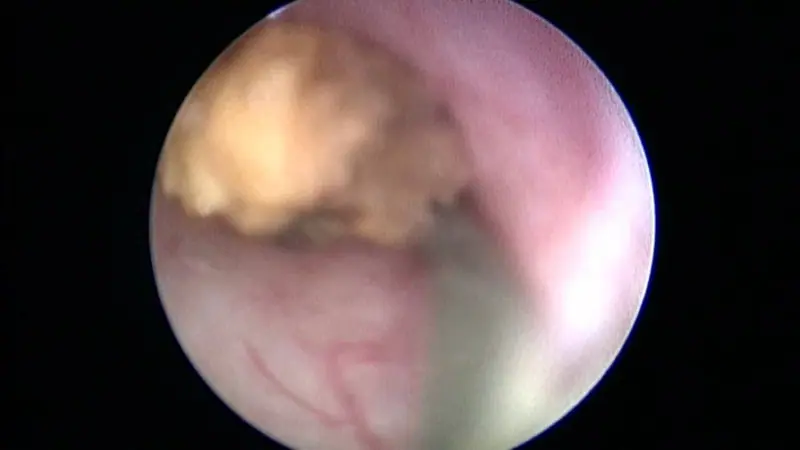
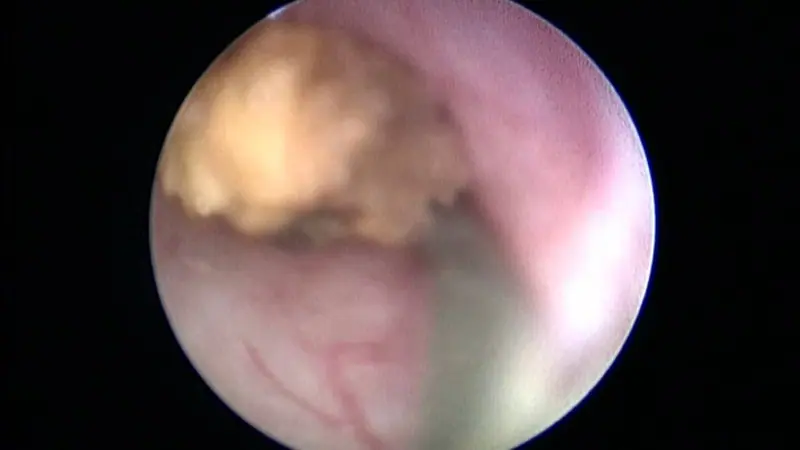
Removal of a ureteral stone by rigid ureteroscopy
Video without narration