Interstitial cystitis
Persistent bladder pain, frequent urges, burning with no infection found? Interstitial cystitis is a rare and often little-known condition. It is diagnosed by ruling out other causes, and treatments are available to relieve it.
In brief
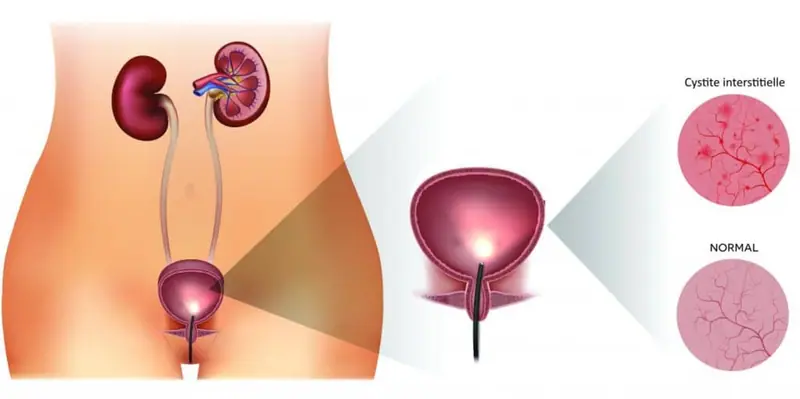
Interstitial cystitis, or bladder pain syndrome, is a rare, chronic condition of the bladder that mainly affects young women and causes pain, burning and a frequent need to urinate, without infection. Diagnosis is made by ruling out other causes, then by cystoscopy; the treatments aim to provide relief: bladder hydrodistension, hyaluronic acid instillations, painkillers, and avoiding the foods that trigger attacks.
Key points
Mainly young women
A rare condition, often recognised late.
It is not an infection
Urine tests find no germs and antibiotics have no effect.
A diagnosis of exclusion
Other causes are ruled out, then a cystoscopy confirms the diagnosis.
Treatments to relieve it
Hydrodistension and hyaluronic acid instillations (Ialuril).
Understanding the condition
Interstitial cystitis (IC) is a rare, under-diagnosed condition. It mainly affects young women.
It causes atypical bladder pain. The mechanism behind this condition is not well understood. It can be triggered by an episode of urinary tract infection.
It is also known as “bladder pain syndrome”. As it is not an infection, antibiotics do not relieve the pain, which often delays the diagnosis.
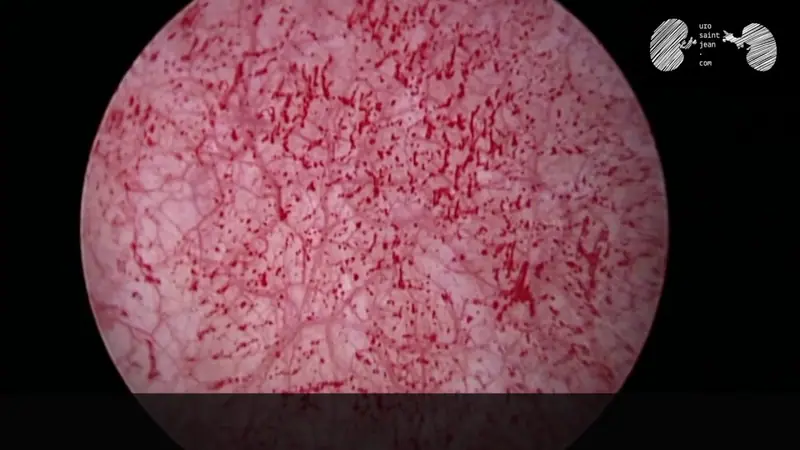
Video without narration
Symptoms
These symptoms often come in flare-ups. They can be made worse by certain foods or drinks (coffee, alcohol, citrus fruit, spices), stress or periods: keeping a note of what triggers your flare-ups helps your urologist.
- Constant bladder pain relieved after passing urine
- Burning
- Urgency (frequent urges)
- Pain during sexual intercourse
Diagnosis
No single test can make the diagnosis.
It is a diagnosis of exclusion: a tumour, infections and other causes will be looked for before this diagnosis is considered.
A bladder ultrasound will always be requested and will be normal.
A urine culture may find white blood cells in the urine without any germs.
If your urologist thinks you may have it, you will be offered a cystoscopy under general anaesthesia: this involves looking inside your bladder with a miniature camera.
There is a pathognomonic sign (if this sign is present, you are sure to have the disease) in IC: Hunner’s lesions. These are spots of blood that appear when the bladder is emptied after being filled: the bladder is said to “weep blood”.
Samples can also be taken during this cystoscopy.
Treatments
Your care at the practice
At the practice, this care is provided by Dr Nicolas Korahanis, Dr Samer Abdel-Hamid, Dr Vincent Abd El Fattah and Dr Bruno Segui.
Consultations take place at the Consultation Centre, in Saint-Jean-de-Védas, and at Polyclinique Saint-Louis, in Ganges. Depending on the operation, it is performed at Clinique Saint-Jean Sud de France or at Polyclinique Saint-Louis.
Why choose URO Saint-Jean?
A rigorous diagnosis
Other causes are ruled out before the diagnosis is made.
Treatments at the clinic
Hydrodistension under anaesthesia and Ialuril instillations.
A listening ear
A condition long overlooked: your pain is taken seriously.




Your questions
Is it a urinary tract infection?
No. Urine tests find no germs and antibiotics do not relieve the pain. Repeated infections should nevertheless be looked for before the diagnosis is made.
Can it be cured?
It is a chronic condition that comes in flare-ups. Treatments can reduce pain, make flare-ups less frequent and greatly improve everyday life.
Does diet play a role?
For some people, yes: coffee, alcohol, citrus fruit, tomatoes, spices or fizzy drinks can trigger flare-ups. A diary helps identify your own triggers.
TEST YOURSELF!
GO TO THE QUESTIONNAIREPage reviewed and approved by Dr Samer Abdel-Hamid, urological surgeon. Updated on . The medical pages of this website are reviewed every year.
Sources
- Fiche info patient – Hydrodistension vésicale pour le traitement des syndromes douloureux vésicaux (ou urétraux) — Association française d’urologie (AFU), 2024
- Le syndrome de la douleur vésicale : une cystite inflammatoire — Association française d’urologie (AFU), 2023
- CHAPITRE 3 Items 40, 41 – Algies pelviennes chez la femme : le syndrome de la douleur vésicale (Référentiel du Collège d’Urologie, 6ème édition) — Association française d’urologie (AFU)
Scientific references
- Corona G, et al. Hyaluronic acid and chondroitin sulphate instillation in chronic bladder diseases: a meta-analysis. BJU International. 2026. doi:10.1111/bju.70016
This information does not replace a medical consultation.