
Penile cancer

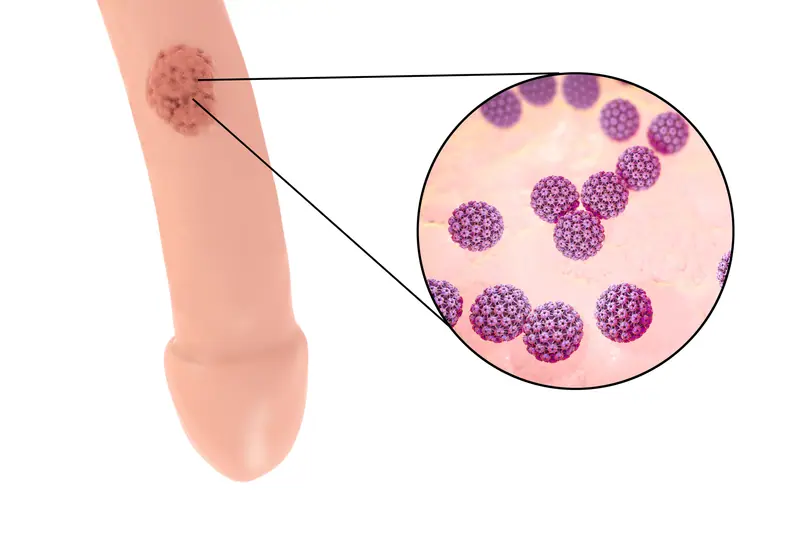
Penile cancer is rare and appears as a lesion on the glans or foreskin that does not heal. Seeing a doctor early makes all the difference: caught early, it can often be treated while preserving the penis.

Book appointment

Reviewed by Dr Samer Abdel-Hamid, urological surgeon · updated on

In brief

Penile cancer, which is rare, appears as a lesion on the glans or foreskin that does not heal. Diagnosis is based above all on clinical examination; depending on its extent, the tumour is treated locally (creams, laser), by brachytherapy or by surgery, limited to the glans or going as far as partial or total amputation of the penis; the groin lymph nodes are examined when it is deeper.

Key points

  • A rare cancer

    It mainly affects men over 60.

  • A lesion that does not heal

    A spot, sore or redness on the glans or foreskin that lasts more than a few weeks: see a doctor.

  • Don’t wait

    Delayed diagnosis is common. Caught early, this cancer is easier and simpler to treat.

  • Protecting yourself

    Good hygiene, treatment of a tight foreskin and HPV vaccination reduce the risk.

Understanding the condition

You have a growth or ulcer on the penis, usually on the glans or even the foreskin.

Epidemiology

This cancer occurs mainly in uncircumcised men aged 60 or over, mostly as squamous cell carcinoma; basal cell carcinomas and melanomas are rare.

There is often a long delay between the first appearance of the lesion and the first specialist consultation.

The main risk factors are known: a foreskin that is too tight (phimosis) and makes washing difficult, certain human papillomavirus (HPV) infections, chronic inflammation of the skin of the glans, and smoking. HPV vaccination, now recommended for boys as well as girls, helps prevent it.

Diagnosis

Diagnosis is above all clinical, based on examination of the penis, the tumour and the lymph node areas in the groin. A biopsy of the tumour is only taken if there is doubt about the diagnosis. Penile MRI or ultrasound can confirm spread to the tunica albuginea (membrane) of the corpora cavernosa if there is doubt.

Depending on the extent of the tumour, a CT scan completes the assessment to look for spread to distant lymph nodes. The consultation is conducted discreetly: do not hesitate to show a lesion, even if it seems harmless to you.

Treatment

For a tumour of the glans, two types of treatment may be offered: partial amputation (AFU sheet, in French) or total amputation (AFU sheet, in French) of the penis, depending on the extent of the tumour on the glans, or organ-sparing treatment of the glans by brachytherapy (implantation of iridium needles) for limited lesions smaller than 30 mm.

If the tumour invades the corpora cavernosa, amputation of the penis is necessary, combined with surgery of the groin lymph nodes.

  • Preserving the organ

    For superficial or limited lesions, local treatments (creams, laser) or surgery limited to the glans, with reconstruction, usually make it possible to preserve the penis and its function.

  • The lymph nodes in the groin

    When the tumour is deeper, the groin lymph nodes are examined, sometimes using the less invasive sentinel node technique, or removed by lymph node dissection. Radiotherapy or chemotherapy may complete the treatment.

  • Support

    Decisions are made at a multidisciplinary team meeting. Psychological and sexological support may be offered to you, both before and after treatment.

After treatment

Complications

For the penis, the after-effects are mainly psychological, linked to the change in body image and the significance of this male organ. Treatment-related complications may be urinary, due to narrowing of the urethra, or sexual, due to loss of penile length or loss of sensation after brachytherapy.

In the groin, complications are common because of the particular anatomy of this area.

Prognosis

The good-prognosis groups combine a small tumour limited to the glans, without invasion of the corpora cavernosa, for which organ-sparing treatment should be offered. The risk of groin metastases is low.

The poor-prognosis groups, due to the presence of lymph node metastases, are tumours that have invaded the corpora cavernosa. Examination of the lymph nodes is essential in these cases.

Documentation

AFU information sheet (in French)

AFU information sheet (in French)

View the sheet (in French)

Your care at the practice

At the practice, this care is provided by Dr Nicolas Korahanis, Dr Samer Abdel-Hamid, Dr Vincent Abd El Fattah and Dr Bruno Segui.

Consultations take place at the Consultation Centre, in Saint-Jean-de-Védas, and at Polyclinique Saint-Louis, in Ganges. Cancer operations are performed at Clinique Saint-Jean Sud de France, in Saint-Jean-de-Védas.

Why choose URO Saint-Jean?

  • A discreet consultation

    A simple, non-judgemental examination to find out quickly what it is.

  • Preserving whenever possible

    The least mutilating treatment is always sought, depending on the extent of the tumour.

  • Multidisciplinary teams

    Urologists, oncologists and radiotherapists decide on your treatment together.

Your questions

Is a lesion on the glans always cancer?

No: most lesions are benign (infection, irritation, skin disease). But a lesion that does not heal within a few weeks should be examined by a doctor.

Does the penis always have to be removed?

No. For tumours limited to the glans, organ-sparing treatments are offered whenever possible. Amputation is reserved for more extensive tumours.

Does circumcision protect?

It reduces the risk, especially when performed in childhood, notably by preventing phimosis. Good hygiene and HPV vaccination are also effective protection.

Will I still be able to have a sex life?

Usually yes, especially after organ-sparing treatment. Talk openly with your urologist: solutions and support are available.

Page reviewed and approved by Dr Samer Abdel-Hamid, urological surgeon. Updated on . The medical pages of this website are reviewed every year.

Sources

This information does not replace a medical consultation.